
National Discounts Seniors Only Get If They Ask
Senior discounts can reduce the cost of clothing, household supplies, travel, hotel stays, and recreation, but many are not applied automatically at checkout. Eligibility ages vary widely, beginning at 55 for some retailers and rising to 60, 62, or 65 elsewhere. Knowing which programs exist—and requesting the correct rate before paying—can turn occasional savings into meaningful annual reductions.
Retail Discounts That May Be Missed at Checkout
Ross Dress for Less offers one of the clearest nationwide senior programs through its 55+ Tuesday Discount. Customers age 55 or older can receive 10% off purchases made on Tuesdays, but the eligible customer must notify the associate at checkout and may be asked to present identification. The discount is nontransferable, making it particularly important to request it before the transaction is completed. (Ross)
Kohl’s provides a 15% discount on qualifying in-store purchases every Wednesday for customers age 60 or older. The savings are limited to eligible merchandise, cannot be combined with another percentage-off coupon, and generally require the customer to identify eligibility during checkout. Because the discount is tied to one day of the week, planning larger clothing or household purchases for Wednesday can produce substantially better savings than shopping on another day. (Kohl's)
Michaels offers customers age 55 and older an additional 10% off qualifying purchases, including many sale items. The program becomes easier to use after senior status is connected to a Michaels Rewards account, allowing the discount to apply in stores and online, although exclusions and daily limits remain. Those who have not completed the verification process should ask about the discount or present identification before paying rather than assuming the cashier will recognize eligibility. (Michaels)
Monthly Savings at Walgreens
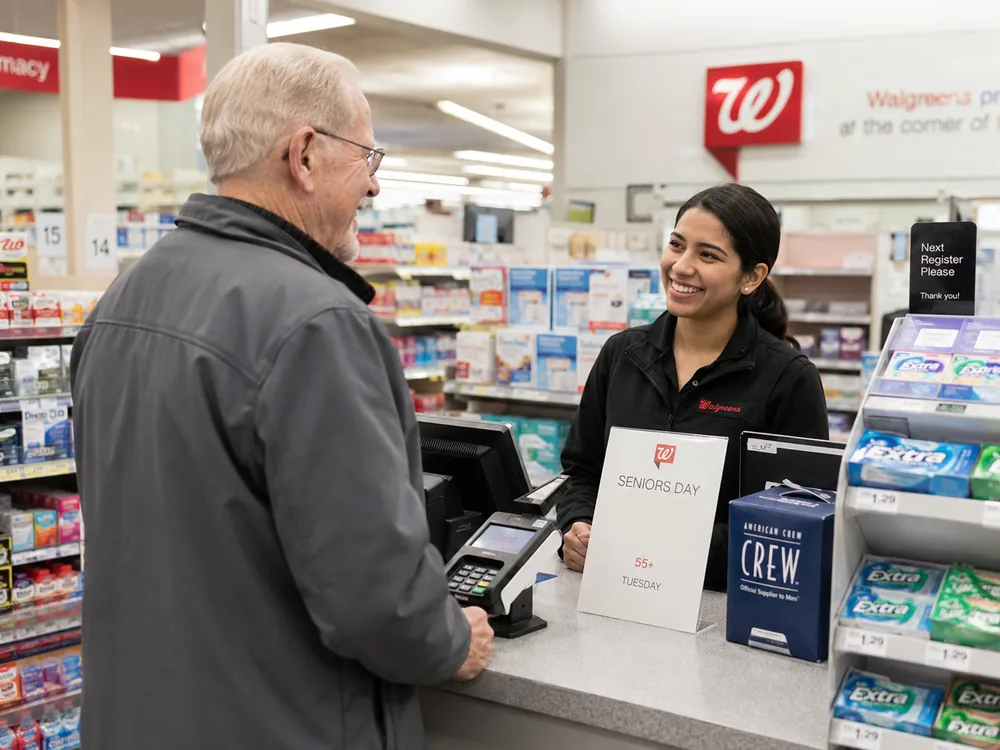
Walgreens holds Seniors Day on the first Tuesday of most months for myWalgreens members age 55 and older. Eligible shoppers can generally save 20% on qualifying regular-priced merchandise, but proof of age may be required and the discount excludes categories such as prescriptions, alcohol, tobacco, gift cards, dairy products, transportation passes, lottery tickets, and certain pharmacy services. Walgreens specifically advises shoppers to tell the cashier they are participating in Seniors Day, making this a literal example of savings that can disappear when no one asks. (Walgreens)
The Walgreens discount can be most valuable when used strategically rather than for products already included in stronger promotions. Regular-priced personal-care products, household essentials, vitamins, home health items, and certain over-the-counter products may qualify, while buy-one-get-one promotions often cannot be combined with the senior offer. Checking the current terms before the first Tuesday of the month helps prevent a planned purchase from falling into an excluded category.
Travel Discounts Require the Correct Fare
Amtrak passengers age 65 and older can receive 10% off most rail fares on most trains. The senior fare is not necessarily the first price displayed during every search, so the passenger category must be selected correctly when booking online or the discount should be requested from an agent. Cross-border services operated with VIA Rail Canada use a lower eligibility age of 60, while route, accommodation, and fare restrictions can affect the final savings. (Amtrak)
Hotel discounts are also easy to miss because they usually appear as special rates rather than automatic reductions. Marriott’s senior program is available to guests age 62 and older at participating properties, while Hilton offers travelers age 65 and older and their families savings of up to 6% off the best available rate at participating hotels. Both programs may require proof of age at check-in, and the senior price should still be compared with advance-purchase, loyalty-member, AAA, and promotional rates because the rate labeled “senior” is not guaranteed to be the cheapest for every stay. (Marriott Help)
A Major Discount for National Parks
One of the most valuable national benefits is the America the Beautiful Senior Pass. U.S. citizens and permanent residents age 62 or older can purchase a $20 annual pass or an $80 lifetime pass covering entrance or standard amenity fees at participating federal recreation sites. At locations charging by vehicle, the pass can cover the passholder and accompanying passengers in a noncommercial vehicle, making the lifetime version potentially valuable for decades of national park and federal recreation visits. (National Park Service)
The Senior Pass is not automatically issued when someone turns 62. It must be purchased, and documentation of age and citizenship or permanent residency may be required. It can also provide discounts on certain expanded amenity fees, although those benefits differ by location and should be confirmed before reserving campsites, tours, or other services.
Ask Before the Transaction Is Finished
Senior discounts are inconsistent because there is no universal eligibility age or standard percentage. One business may begin its program at 55, another at 60 or 62, and another at 65; participating locations, excluded products, and available dates may also change. The safest habit is to ask whether a senior rate exists before paying, booking a room, or confirming transportation.
Identification and free loyalty-program registration may be required, while hotel and travel savings often depend on choosing a specific rate during booking. Senior prices should also be compared with ordinary promotions rather than accepted automatically as the best deal. The largest savings come not from using every program, but from knowing which national discounts apply to purchases already being made—and remembering to request them at the right moment.